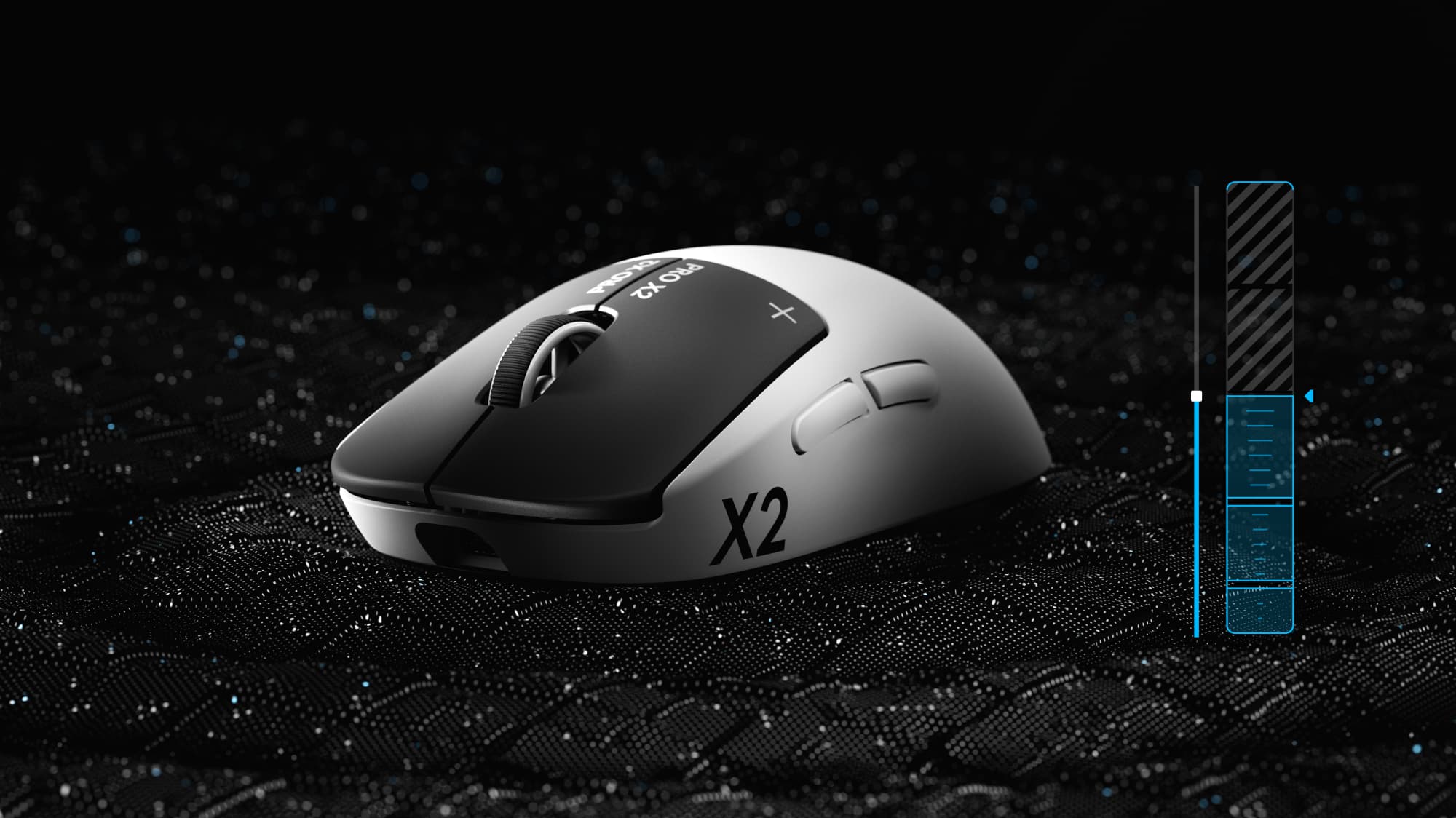
the logitech g pro x2 superstrike replaces mechanical switches with haptic induction. 61 grams, 90-hour battery, 8,000 Hz polling. No gimmicks — just faster clicks.
There's a moment, the first time you press the left click on the logitech g pro x2 superstrike, where your brain says something is wrong. There's no click. No tactile snap. No tiny mechanical event confirming that yes, you did the thing.
Instead, there's a subtle vibration. A ghost of a click. And then your shot lands before you've even finished processing what just happened.
That's the pitch. And for once, it actually holds up.
what logitech actually changed
The superstrike replaces the mechanical microswitches found in essentially every gaming mouse on the market with something logitech calls HITS — Haptic Inductive Trigger System. Instead of a metal contact leaf bending to close a circuit, an electromagnetic induction system detects your click electronically. A haptic motor then simulates the feel of a click, so your fingers still get feedback.
Think of it as the mouse equivalent of hall effect keyboards. If you've used a board with adjustable actuation — where you set exactly how far a key needs to travel before it registers — you already understand the concept. The superstrike brings that same idea to its left and right mouse buttons, with 10 levels of actuation depth across just 0.65 mm of total travel, plus 5 levels of rapid trigger reset.
The practical result: logitech claims up to 30 ms faster click latency compared to traditional mechanical switches. That number has held up in independent testing, and it's significant. Most generational improvements in mouse latency are measured in microseconds. This is measured in milliseconds — a different order of magnitude entirely.
the specs that matter
SpecDetailWeight61 g (with PTFE puck)SensorHERO 2 — 44,000 DPI, 888 IPS, 88 GPolling RateUp to 8,000 Hz (LIGHTSPEED wireless)BatteryUp to 90 hoursChargingUSB-C (PowerPlay 2 compatible)Click SystemHITS — haptic inductive, 10-level actuation, 5-level rapid triggerButtons5 total (left, right, 2 thumb, scroll click)ShapeIdentical to Pro X Superlight 2RGBNonePrice$179.99
who this is actually for
Let's be direct. If you play Counter-Strike, Valorant, Apex Legends, or any other competitive FPS where reaction time is the margin between winning and losing, the superstrike is the most advanced tool available right now. The adjustable actuation and rapid trigger let you tap-fire and spam-click without fully lifting your finger between inputs. Professional players across G2 Esports, NAVI, and BLG helped develop and test it.
If you play Stardew Valley and browse Reddit, you don't need this mouse. And that's fine.
The superstrike also makes an interesting case for accessibility. The reduced physical effort required to register clicks — and the ability to tune exactly how much force and travel you want — means people with hand fatigue, motor disabilities, or joint issues may find this significantly more comfortable than a traditional mechanical switch over long sessions.
what we appreciate
No RGB. Logitech left it out to preserve battery life and keep the weight down. That's the kind of trade-off we respect — function over flash.
The shape is proven. Rather than redesigning the shell for the sake of novelty, logitech kept the exact same chassis as the Pro X Superlight 2, one of the most widely used competitive mouse shapes ever made. If it works for hundreds of professional players, there's no reason to fix it.
The battery life is honest. 90 hours under constant motion is a real-world number, not a marketing fantasy measured with the mouse sitting idle. USB-C charging is standard. PowerPlay wireless charging is supported if you want to never think about battery again.
Software customization goes deep. Through G Hub, you can tune actuation depth, rapid trigger sensitivity, haptic feedback strength, and save profiles per game. You can even export your settings as a shareable code.
what to know before buying
The two-tone black and white colorway with motion-tracking crosshair graphics is the only option at launch. It's understated by gaming mouse standards, but it won't be invisible on your desk either.
At $179.99, it's a premium. About 13% more than the already expensive Superlight 2. You're paying for genuinely new technology, not a spec bump.
The five-button layout is minimal — just two thumb buttons. If you rely on extra macro buttons for productivity or MMOs, this isn't your mouse. The superstrike is laser-focused on competitive play.
G Hub software is required to adjust HITS settings, and at the time of early reviews, settings don't persist on the mouse without the software running. That's a notable limitation for tournament players or anyone who prefers a software-free setup.
the bottom line
The logitech g pro x2 superstrike is the first mouse to make a genuinely compelling argument that the mechanical microswitch era is ending. Not because mechanical switches are bad — they've served us well for decades — but because inductive sensing with haptic feedback offers more control, less latency, and better customization at a negligible weight and battery cost.
It's not for everyone. It doesn't try to be. And that restraint is exactly what makes it worth paying attention to.
The world doesn't need more mice. It needs better ones.